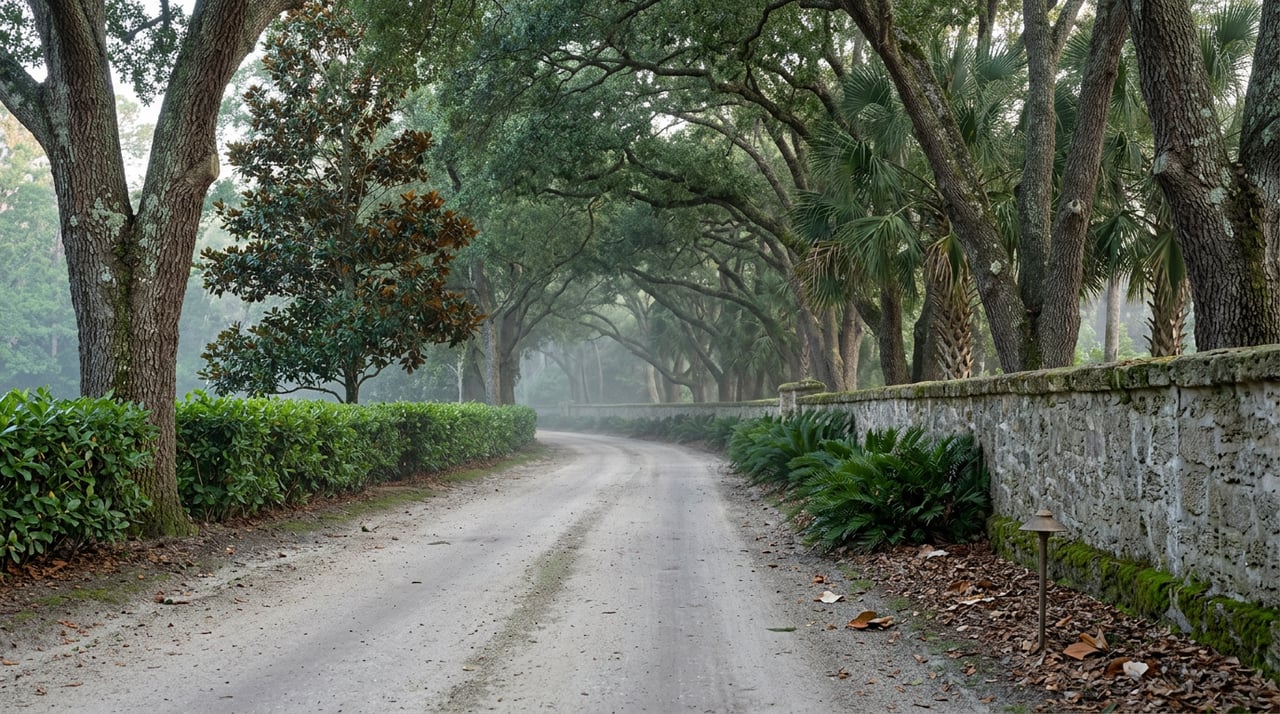
Most people who park at Robbins Preserve off Hiatus Road do the same loop every time. Roughly a mile and a half of shaded path, past the spot where the sandy equestrian track runs alongside the pavement, back to the car in under an hour. It's a good walk. It is also, without most people realizing it, only one link in a chain.
A narrower trail breaks off from that same preserve and keeps going west. It has an official name, the Robbins Vista View Trail, and almost nobody who lives within five minutes of it could tell you where it leads. It leads to Vista View Park. Then it leads further, into Long Key Natural Area, a 164.8-acre property with its own nature center, its own archaeological history, and its own set of rules that have nothing to do with the ones you just left behind at Robbins Preserve.
Four Names, One Corridor
Tree Tops Park, Robbins Preserve, and Long Key Natural Area get treated in most local guides as three unrelated stops on a list of things to do in Davie. They are not unrelated. They sit on the same elevated oak ridge system that runs through the western part of town, and in at least one case they are connected by an actual, walkable trail that most residents have never used.
Tree Tops Park is the oldest and largest of the three, created in 1980 on 243.3 acres that were originally slated to become a golf course before Broward County stepped in. It now serves as the gateway to Pine Island Ridge Natural Area, and the combined site is recognized as a Broward Cultural Heritage Landmark, a designation posted right at the nature center. The main loop through Tree Tops runs 1.3 miles.
Robbins Preserve, at 4005 S Hiatus Rd, is smaller and newer to most residents' radar, a 60-acre property with a 1.4-mile loop that mixes paved sections with sandy stretches built for horses. It is genuinely shared-use, which means on any given walk you might be sharing the path with a cyclist, a rider, or both.
Long Key Natural Area, at 3501 SW 130th Ave, is the quiet end of the chain. At 164.8 acres it is one of the largest natural areas Broward County Parks and Recreation manages, and its trail system includes paved, primitive, and equestrian options depending on which entrance you take.
Here is the detail that actually matters if you plan to walk more than one of these in a day: the rules change as you cross from one property into the next, and nothing on site tells you that in advance.
| Park | Acreage | Main Loop | Dogs |
|---|---|---|---|
| Tree Tops Park | 243.3 | 1.3 miles | Leashed dogs welcome, but not on the adjoining Pine Island Ridge section |
| Robbins Preserve | 60 | 1.4 miles | Leashed dogs permitted on shared-use trails |
| Long Key Natural Area | 164.8 | About 1 mile | Dogs are not permitted anywhere on site |
That last line surprises people. You can bring a leashed dog through most of Tree Tops Park and through all of Robbins Preserve, but the moment you cross into Long Key, the rule flips entirely. If you set out planning to walk the whole corridor with a dog on a leash, you will need to turn around before the Long Key entrance or plan a separate trip.
The Trail With No Name Residents Actually Use
The Robbins Vista View Trail is the walkable link between Robbins Preserve, Vista View Park, and Long Key Natural Area; Tree Tops Park is not on this trail. It runs west from Robbins Preserve, past Vista View Park, and connects into the Long Key Ridge System along SW 142nd Avenue, about a half-mile north of Orange Drive. The Town of Davie's own page for the trail describes what used to sit on that ground: the Kapok Tree Restaurant and the Pioneer City theme park, a Western-themed attraction that once drew visitors before the land was folded into what the town now classifies as Environmentally Sensitive Land.
The same stretch has a second, less romantic history. Before it became protected trail, part of this ground was a landfill, later designated a Superfund site, that received a clean bill of health in the 1990s. That is not a footnote you'll find on a trailhead sign. It is on the Town of Davie's own official trail page, and it means the quiet oak hammock you're walking through today was reclaimed industrial land within living memory.
What an 1841 Survey Recorded on This Same Ridge
Long Key's history goes back further than the restaurant and the landfill. Long before either existed, this elevated ground was one of a series of islands rising out of the surrounding Everglades marsh, occupied by the Tequesta and later the Seminole. Traces of settlement here go back roughly 3,000 years, and the site's own historical group, Friends of Long Key, preserves a written account from a U.S. military engineer surveying the area in 1841, describing the largest of these islands as
"about one hundred and fifty yards in width and half a mile in length"
with three villages and dancing grounds on it. That island is the ground under today's Long Key Natural Area. The 12-minute film shown in the site's Everglades Theater, and the exhibit hall built over an actual archaeological dig pit, both trace back to that same 1841 description of high, dry land in the middle of a swamp, which is exactly why it was worth living on then and worth protecting now.
The Town Just Finished Filling In the Middle
None of this corridor is static. On August 4, 2026, the Town of Davie announced it had completed a native tree planting project specifically targeting the ground between Bamford Sports Complex at Pine Island Park and Robbins Preserve. Crews removed 22 Category I invasive tree species and replaced them with 71 native and Florida-friendly trees, work funded through the 2025 Urban and Community Forestry Plantings, Preservation, and Invasives Control grant, administered by the Florida Department of Agriculture and Consumer Services and funded by the U.S. Department of Agriculture Forest Service.
Mayor Judy Paul framed the project as ongoing civic habit rather than a one-off improvement, saying "every tree we plant is an investment in Davie's future." That framing holds up against the record. Davie has held Tree City USA status for 35 straight years, and this project reads less like a single grant-funded cleanup and more like the town continuing to knit its own park system together, one invasive stand at a time, in the broader park corridor described here.
How to Actually Walk It
If you want to visit Tree Tops Park before walking the connected route from Robbins Preserve through Vista View Park to Long Key, start with the 1.3-mile loop at Tree Tops Park, 3900 SW 100th Ave, through the oak canopy toward Pine Island Ridge. Leashed dogs are fine here, but leave them behind before the Pine Island Ridge crossing. From there, the closest practical restart point is Robbins Preserve at 4005 S Hiatus Rd, where the 1.4-mile shared-use loop picks up and the Robbins Vista View Trail breaks off to the west. Follow it past Vista View Park and into Long Key Natural Area at 3501 SW 130th Ave, open daily from 9 a.m. to 5 p.m., where the dog rule ends and you will need to have already made other arrangements for the leash.
Give horses room on the shared sections. Watch for cyclists moving faster than the pace of the trail suggests, particularly on the paved stretches near Robbins Preserve. And budget more time than the individual mileage implies, since the connective trail between properties runs longer than any single park's marked loop.
Living in a place like this means the value isn't only in the acreage behind your own hedge line. It's in the fact that a working trail system, still being actively replanted and reconnected by the town as of this year, runs from your neighborhood into thousands of years of local history without you ever getting in a car.
If you already call Davie's western half home, or you're weighing what a property here actually connects you to, Tommy Crivello works this exact corridor of Southwest Broward every week. Reach out to talk through what a specific address puts you within walking distance of, not just what it looks like from the street.