Why would a town schedule its gardening classes for November, when gardeners in most of the country are putting their tools away? Davie's free monthly Gardening Workshops start this Saturday, Nov. 14, at the Davie Community Garden, 4005 S. Hiatus Road. They run once a month through March 2027, and every session is a Saturday from 9 to 10 a.m. Admission and parking are free. Gardening experts lead each session, with hands-on demonstrations covering plant nutrition, soil preparation and watering.
That window matches the months when gardening in Broward works best. The second session, on palm nutrition, deals with a problem on a much longer clock than any vegetable bed.
Fall is planting season here
The UF/IFAS Broward County Extension planting guide calls fall the preferred planting season in South Florida, even though Florida gardens can technically be planted any month of the year. The statewide UF/IFAS Florida Vegetable Gardening Guide shows how far Davie's calendar sits from North Florida's. It defines "South" as everything below State Road 70, which puts all of Broward in the southern column.
| Crop | South Florida planting window | North Florida planting window |
|---|---|---|
| Beans | September through April | March to April, then August to September |
| Broccoli | October through January | September through February |
In South Florida, beans have an eight-month planting window that covers the whole winter. In North Florida the same crop gets two short windows, one on either side of summer. Davie's workshop series runs from November to March, so all five sessions fall inside the months when the state's own guide says the southern part of Florida plants the most.
The summer side explains the rest. UF/IFAS warns that vegetables planted in August and September face the insects and diseases that thrive in hot weather. Its crop notes add that warm temperatures can make lettuce bitter and radishes spicy or bitter, and that spinach grows best in the coolest months. In Davie, the season for lettuce, radishes and spinach is the stretch the Town's workshop calendar covers.
Saturday's session and the plot you can't leave empty
The Nov. 14 session is "Plant Nutrition: Helping Us Grow." It's the right first lesson for anyone thinking about a plot at the garden on Hiatus Road, because the Town's rules for plot holders assume you'll keep growing after spring.
The Town of Davie Community Gardens Participant Memorandum of Understanding sets out the terms. The Parks, Recreation and Cultural Arts Department runs the gardens. According to that document:
- The fee is $30 per plot for the year running Aug. 1 to July 31. Joining on or after Feb. 1 costs $15 for the half year, and fees are not refunded.
- Gardeners must plant within two weeks of getting a plot and garden year-round. A plot can't sit unused for three weeks or longer more than once a year, and after six weeks the plot is forfeited and reassigned.
- Plots measure 10 by 10 feet or 12 by 4 feet. Plants can't grow higher than six feet, and Town residents get priority.
- Using any pesticide requires Town approval first.
The year-round rule ties back to the calendar. A plot holder who stops when lettuce turns bitter in the heat will run into the fallow limit, so the summer months need different crops. The UF/IFAS month-by-month guide for South Florida lists them. May suits sweet potatoes, hot peppers and tropical spinach, and June and July suit tropical vegetables. Its fall and winter months list far more cool-season crops. Signing up in November means starting a plot at the easy end of the year.
Dec. 5 is about palms, which run on a longer clock
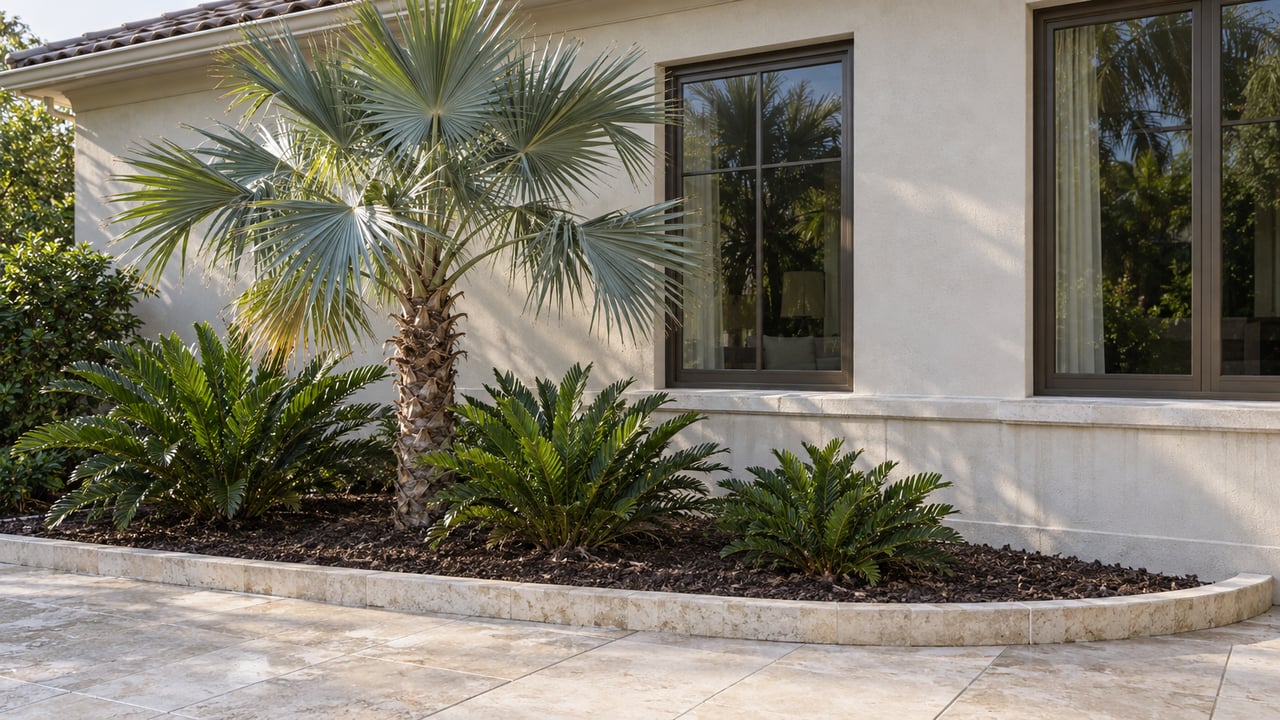
The second workshop, "Feeding Fronds: Nutrition and Management for Palm Health," is on Saturday, Dec. 5. It's the session most relevant to anyone with a property lined with palms, whether or not they ever plant a vegetable.
UF/IFAS says deficiencies of nitrogen, potassium, magnesium, iron, manganese and boron are common to some degree in palms growing on peninsular Florida soils. Its guide to palm nutrient deficiencies explains how to tell several of them apart by where they appear on the tree:
Potassium. UF/IFAS calls this the most common nutritional disorder in palms. It shows up first on the older leaves, as yellow spotting, dead tissue along leaflet edges and tips, and frizzled leaflets.
Magnesium. Also on the oldest leaves, but here the yellowing runs along the margins while the center of the leaf stays green.
Manganese. This one starts at the top of the tree. New leaves come out yellowed with long dead streaks and can curl and frizzle, a pattern known as "frizzletop."
Boron. Also on emerging growth. Leaflet tips can hook sharply, or spear leaves may fail to open normally.
Older leaves point to potassium or magnesium. New growth points to manganese or boron.
Why fixing it takes years
The UF/IFAS publication Fertilization of Field-Grown and Landscape Palms in Florida explains why a palm session belongs on a seasonal workshop calendar. It says nutrient deficiencies are easier to prevent than to correct, and that correcting some can take two or three years. For some nutrients, a palm that shows a deficiency this November may not be corrected until 2028 or 2029.
UF/IFAS research has found that regular use of an 8N-2P2O5-12K2O+4Mg fertilizer with micronutrients can correct mild to moderate deficiencies, and prevent them from coming back, in most soils in south and central Florida. The publication adds that a badly formulated product with the same numbers on the label can be worse for the palm than no fertilizer at all.
What matters is how fast the nutrients release. UF/IFAS says all of the nitrogen, potassium and magnesium should be in slow-release form, because Florida soils hold these elements poorly during heavy rain or irrigation. A water-soluble product spread one day can be washed out of the root zone by a hard rain the next, and the palm gets nothing from it. Most micronutrients are the opposite case and need to be water-soluble, though UF/IFAS considers granular slow-release boron safer and more effective in Florida landscape soils.
How the fertilizer goes down matters too. UF/IFAS finds that fertilizer placed in holes, used as spikes or banded around the trunk works less well than the same amount spread evenly under the whole canopy. Nutrients move almost entirely straight down, so concentrated fertilizer reaches only a small part of the root system and is more likely to burn roots. The publication also recommends against injecting water-soluble fertilizer into the root zone.
The schedule is where Davie differs from much of the state. UF/IFAS recommends applying the maintenance blend every three months, at 1.5 pounds of product per 100 square feet of palm canopy, bed or landscape area in South Florida. For central and north Florida landscapes, it says the winter application can be skipped. In Davie, the early-December workshop lands in the season when palm owners farther north are told they can take a break.
The rest of the season
After December, the series moves from feeding plants to everything else that lives in a South Florida garden:
- Jan. 9, 2027: "Meet Your Neighbors: Helpful Insects vs. Garden Invaders"
- Feb. 13, 2027: "Native Orchids Talk"
- March 13, 2027: "Blossom to Bowl: Growing Tropical Fruits"
The March session on tropical fruit is the last one before the heat returns. All five are at the same garden on Hiatus Road, at the same 9 a.m. start, according to the Town of Davie announcement. For questions about the workshops or plot availability, contact Park Ranger Suzanne Joswick at 954-797-1145 or [email protected], or the Parks, Recreation and Cultural Arts Department at 954-797-1159. The plot fees and rules above come from the Town's agreement. This post is general information, not legal or financial advice, so confirm the current terms with the department before you apply.
Mature, well-fed palms and planting beds are a big part of how an estate shows to a buyer, and as UF/IFAS makes clear, that condition builds over years of care. If you're weighing how your grounds factor into what your Davie property is worth, Tommy Crivello Group brings an appraiser's eye to land and landscape alike. Request a Private Valuation.